


Snoring appliance Konyaaltı
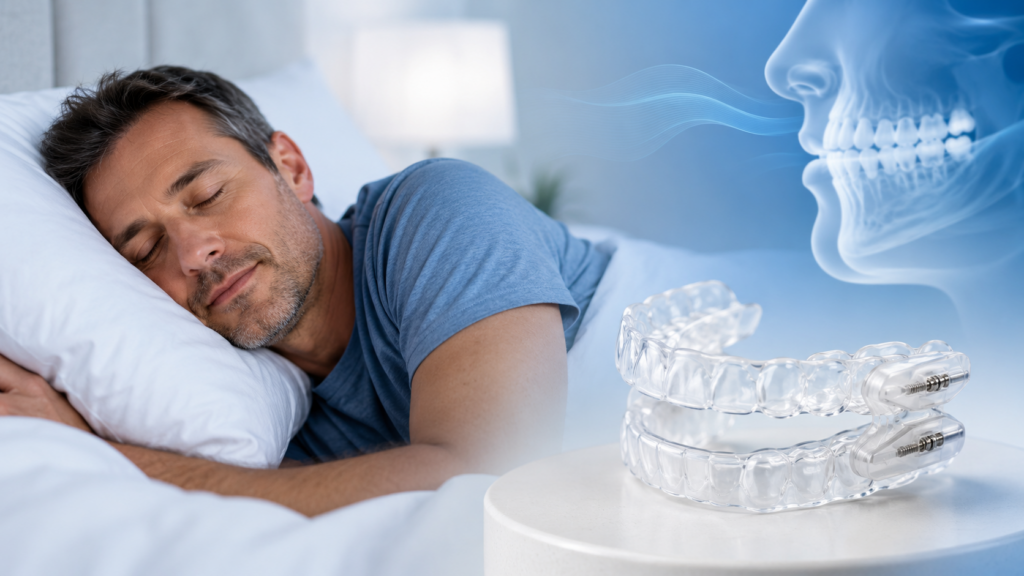
Snoring appliance Konyaaltı is a focused search term for patients who struggle with loud snoring, disturbed sleep, dry mouth in the morning, jaw-related airway narrowing, partner complaints or suspected sleep-related breathing discomfort. Dr. Yaşar Özdemir evaluates snoring appliance treatment in Konyaaltı by examining the teeth, gums, jaw relationship, bite, temporomandibular joint, lower jaw movement, oral tissues and the patient’s sleep-related complaints together. The purpose is not simply to reduce noise during sleep, but to determine whether an individually planned oral appliance can support a more comfortable airway position.
Snoring is often treated as a social problem, but it can sometimes be linked to more serious sleep-related breathing issues. In many patients, snoring occurs when airflow becomes restricted and soft tissues in the throat vibrate during sleep. Tongue position, soft palate movement, nasal obstruction, sleeping position, weight, jaw structure and muscle relaxation can all influence snoring. For this reason, a snoring appliance should not be chosen randomly without understanding the possible cause.
A dental snoring appliance is usually designed to position the lower jaw slightly forward during sleep. This can help reduce airway narrowing caused by the tongue and surrounding soft tissues in suitable patients. However, not every person who snores is a suitable candidate. Dr. Yaşar Özdemir first evaluates whether the teeth, gums and jaw joints can tolerate such an appliance safely.
Snoring appliance Konyaaltı: Who can benefit from it?
Snoring appliance Konyaaltı may be suitable for patients who experience simple snoring or who have been advised to consider an oral appliance after sleep-related evaluation. It may also be considered in selected mild to moderate obstructive sleep apnea cases when medically appropriate. However, proper diagnosis is essential before deciding on appliance therapy.
Patients who may benefit from a snoring appliance often have snoring that worsens while sleeping on the back, a lower jaw that sits relatively backward, or airway narrowing related to tongue position. In these cases, moving the lower jaw slightly forward may help keep the airway more open during sleep. This can reduce the vibration that causes snoring in suitable cases.
However, a snoring appliance may not be suitable for everyone. Patients with severe untreated sleep apnea, advanced gum disease, loose teeth, many missing teeth, serious jaw joint pain, uncontrolled medical conditions or major nasal obstruction may need a different approach. If snoring is caused mainly by nasal blockage, tonsil enlargement or other airway problems, a dental appliance alone may not be enough.
Dr. Yaşar Özdemir evaluates oral suitability before recommending a snoring appliance. When symptoms suggest sleep apnea or airway-related medical concerns, additional evaluation by a sleep physician or ENT specialist may be recommended.
Snoring appliance Konyaaltı and the importance of proper evaluation
Snoring appliance Konyaaltı treatment should begin with a detailed dental and functional evaluation. An oral appliance affects the teeth, bite, jaw muscles and jaw joint. If the appliance is not planned correctly, it may cause discomfort, tooth pressure, joint pain or difficulty sleeping.
During the consultation, the teeth are checked for stability, decay, old crowns, fillings, implants and gum health. The dentist also evaluates the bite relationship, jaw movement and temporomandibular joint. If there is clicking, locking, pain or limited mouth opening, the appliance must be planned carefully.
Sleep-related symptoms are also discussed. Loud snoring, witnessed breathing pauses, waking up choking, morning headaches, daytime sleepiness, high blood pressure or constant fatigue may suggest sleep apnea. These symptoms require medical attention and should not be treated as simple snoring without proper evaluation.
Dr. Yaşar Özdemir explains whether the oral condition is appropriate for appliance therapy. The patient understands what the appliance can do, what its limits are and when additional medical evaluation may be needed.
How does a snoring appliance work?
A snoring appliance works by positioning the lower jaw slightly forward during sleep. This forward position can help move the tongue base away from the back of the throat and support a more open airway in suitable patients. When airflow passes more freely, soft tissue vibration may decrease, and snoring may be reduced.
Most dental snoring appliances are worn in the mouth during sleep. They usually cover the upper and lower teeth and are designed to hold the lower jaw in a controlled position. The amount of forward positioning must be planned individually. Too little advancement may not be effective, while too much advancement may cause jaw discomfort.
The appliance should fit securely but comfortably. A loose appliance may not work well during sleep. A tight or poorly adjusted appliance may create pressure on teeth or gums. This is why custom-made appliances are preferred over generic, non-personalized products.
Dr. Yaşar Özdemir plans the appliance according to the patient’s teeth, jaw movement and bite tolerance. The goal is controlled support, not forceful jaw positioning.
Custom snoring appliance vs ready-made devices
Many patients see ready-made snoring devices online and wonder whether they are enough. Standard devices may seem practical, but they do not account for individual dental structure, gum health, jaw joint condition or bite relationship. A poorly fitting device may be uncomfortable, ineffective or harmful.
A custom snoring appliance is made after dental examination and impressions. It is designed for the patient’s mouth, which can improve stability and comfort. The dentist can also check whether the appliance places too much pressure on certain teeth or causes jaw strain.
Ready-made devices may not stay in place during sleep. They may also push the lower jaw too far forward or sit unevenly on the teeth. This can cause morning jaw pain, tooth sensitivity or gum irritation. Patients with crowns, implants, bridges or gum problems should be especially careful with non-custom devices.
Dr. Yaşar Özdemir recommends proper evaluation before appliance use. A snoring appliance should be planned as a clinical treatment, not only as a product.
Snoring appliance and sleep apnea
A snoring appliance is not a replacement for medical diagnosis of sleep apnea. Sleep apnea is a condition in which breathing repeatedly stops or significantly decreases during sleep. It can be associated with loud snoring, daytime sleepiness, morning headaches, poor concentration, waking up choking and cardiovascular risks.
Oral appliances may be considered in selected mild to moderate obstructive sleep apnea cases under appropriate medical guidance. However, severe sleep apnea may require CPAP therapy, medical treatment, weight management, ENT evaluation or other approaches. This decision should be made with proper sleep assessment.
If a patient only treats the snoring sound but ignores breathing pauses, the underlying problem may continue. This is why symptoms such as witnessed apnea, severe daytime sleepiness or waking up gasping should be taken seriously. In such cases, a sleep test may be necessary.
Dr. Yaşar Özdemir does not present a snoring appliance as a universal sleep apnea cure. If sleep apnea is suspected, the patient is guided toward a more complete medical evaluation.
Snoring appliance and CPAP: What is the difference?
CPAP and snoring appliances work in different ways. CPAP uses positive air pressure to keep the airway open during sleep. It is commonly used for obstructive sleep apnea, especially moderate to severe cases. A snoring appliance, on the other hand, works mechanically by positioning the lower jaw forward.
CPAP is a medical device and usually involves a mask connected to a machine. Some patients tolerate it well, while others struggle with mask discomfort, dryness, air pressure or sleep disruption. Oral appliances may be considered in selected patients who cannot tolerate CPAP, but this should be decided with medical guidance.
A snoring appliance is smaller and worn inside the mouth. It may be easier for some patients to use, but it is not suitable for every airway condition. Its success depends on anatomy, snoring cause, sleep apnea severity and patient compliance.
Dr. Yaşar Özdemir evaluates the dental suitability of oral appliance therapy. If CPAP or medical sleep treatment is more appropriate, this should be addressed through the relevant specialist.
Snoring appliance and jaw joint health
A snoring appliance changes the position of the lower jaw during sleep. For this reason, the temporomandibular joint must be evaluated before treatment. Patients who already have jaw joint pain, clicking, locking, limited opening or muscle tension may need more careful planning.
Some mild jaw muscle tiredness can occur during the first adjustment period. However, significant pain, worsening clicking, difficulty opening the mouth or long-lasting bite changes should not be ignored. The appliance may need adjustment or temporary discontinuation.
The lower jaw should not be advanced more than the patient can tolerate. Adjustable appliances can sometimes help because the jaw position may be advanced gradually. This allows the patient to adapt more comfortably and helps the dentist find a more balanced position.
Dr. Yaşar Özdemir evaluates jaw function before and after appliance delivery. The aim is to reduce snoring while protecting jaw comfort and joint health.
Snoring appliance and dental health
A snoring appliance is supported by the teeth, so dental health is very important. Loose teeth, untreated gum disease, active decay, painful teeth or unstable restorations can make appliance use risky. These issues should be treated before the appliance is made.
The appliance should distribute pressure evenly. If it pushes too strongly on certain teeth, the patient may feel sensitivity or discomfort. Patients with bridges, crowns, implants or many restorations need careful appliance design to avoid unwanted pressure.
Long-term uncontrolled appliance use can sometimes affect bite relationship. This is why regular follow-up is important. The dentist should check whether the appliance still fits correctly and whether the teeth, gums and jaw remain healthy.
Dr. Yaşar Özdemir examines the mouth before appliance therapy. If dental treatment is needed first, the patient is informed clearly.
What symptoms suggest that a snoring appliance may be needed?
Patients usually consider a snoring appliance because their partner notices loud or frequent snoring. However, there may be other signs as well. Morning dry mouth, waking up with throat irritation, restless sleep, jaw-related airway narrowing or snoring that worsens on the back can lead patients to seek help.
Some symptoms require more caution. Waking up choking, witnessed breathing pauses, severe daytime sleepiness, morning headaches, poor concentration and high blood pressure may suggest sleep apnea. In these cases, dental appliance planning should be coordinated with medical evaluation.
Patients should also consider whether they have jaw discomfort or dental problems. If they wake up with jaw pain, tooth pressure or headaches, bruxism may also be present. Snoring and teeth grinding can sometimes coexist, and the appliance design must consider both issues.
Dr. Yaşar Özdemir listens to the patient’s sleep and dental complaints together. This helps determine whether a snoring appliance is a reasonable option or whether another evaluation is needed first.
How is a snoring appliance prepared?
The preparation process starts with examination. Teeth, gums, restorations, jaw movement and bite are evaluated. If the patient is suitable, measurements or digital records are taken so that the appliance can be made specifically for the mouth.
The appliance is designed to fit the upper and lower teeth while holding the lower jaw in a planned forward position. The amount of advancement is selected according to comfort, anatomy and treatment goal. Some appliances allow gradual adjustment, which can be useful during adaptation.
When the appliance is delivered, the fit is checked in the mouth. The dentist evaluates retention, pressure areas, jaw position and comfort. The patient is taught how to insert, remove, clean and store the appliance. Follow-up is important because small adjustments may be needed after real night use.
Dr. Yaşar Özdemir plans appliance delivery as a controlled process. The patient does not simply receive an appliance; they also receive usage instructions and follow-up guidance.
Is it difficult to sleep with a snoring appliance?
Sleeping with a snoring appliance may feel unusual at first. The mouth contains a new device, and the lower jaw is held slightly forward. Some patients adapt quickly, while others need several nights or weeks to become comfortable.
At the beginning, patients may notice increased saliva, mild jaw tiredness, tooth pressure or a temporary feeling that the bite is different in the morning. Mild adaptation symptoms can be expected, but pain or strong discomfort should be checked.
The appliance should not feel like it is forcing the jaw aggressively. If the patient cannot sleep, wakes up with jaw pain or feels tooth pressure that does not improve, the appliance may require adjustment. Patient feedback is very important in this process.
Dr. Yaşar Özdemir explains the adaptation period before use. Patients know what is normal and when they should return for control.
How long does it take for a snoring appliance to work?
The effect of a snoring appliance varies from person to person. Some patients notice improvement quickly, while others need gradual adjustment. The result depends on the cause of snoring, airway anatomy, lower jaw response, sleep position, body weight and appliance use consistency.
A snoring appliance can only help when it is worn regularly. If it is used only occasionally, results may be inconsistent. If the appliance is worn properly but snoring continues, adjustment may be needed. In some cases, another cause such as nasal obstruction or sleep apnea may be involved.
Partner feedback can be useful, but it is not the only measure. The patient’s sleep quality, morning dryness, fatigue and any breathing concerns should also be monitored. If symptoms suggest sleep apnea, a sleep study may be necessary even if snoring seems reduced.
Dr. Yaşar Özdemir follows the patient after appliance delivery. Adjustments and controls help improve comfort and effectiveness.
Snoring appliance and nasal obstruction
Nasal obstruction can strongly influence snoring. If a patient cannot breathe well through the nose, mouth breathing during sleep may increase. This can contribute to throat dryness, soft tissue vibration and louder snoring. In such cases, a snoring appliance may not solve the full problem by itself.
Common causes of nasal obstruction include deviated septum, allergies, chronic rhinitis, sinus problems, enlarged turbinates or other ENT-related conditions. If nasal breathing is poor, ENT evaluation may be needed before or alongside appliance therapy.
A dental appliance mainly affects jaw and tongue position. It does not open the nasal airway directly. Therefore, patients should mention chronic nasal blockage, mouth breathing or sinus symptoms during consultation.
Dr. Yaşar Özdemir considers snoring as a multifactorial issue. When nasal obstruction appears to be important, additional medical evaluation may be recommended.
Snoring appliance and teeth grinding
Some patients who snore also clench or grind their teeth during sleep. This is important because the appliance design must consider both airway support and bite forces. A patient with strong bruxism may place heavy pressure on the appliance and teeth.
Signs of teeth grinding include morning jaw fatigue, headaches, worn teeth, broken fillings, tooth sensitivity and tight jaw muscles. If these signs are present, the dentist must evaluate whether a snoring appliance can be used safely and whether additional protection is needed.
A regular night guard and a snoring appliance are not the same. A night guard usually protects teeth from grinding forces. A snoring appliance positions the jaw forward to support the airway. In some cases, the appliance design must balance both needs carefully.
Dr. Yaşar Özdemir evaluates grinding habits before appliance treatment. The plan should protect teeth while addressing snoring-related concerns.
Snoring appliance and morning jaw discomfort
Some patients may experience mild morning jaw discomfort when they first start using a snoring appliance. This can happen because the lower jaw is held in a different position during sleep. In many cases, the muscles adapt gradually.
However, discomfort should not be severe or persistent. If the patient wakes up with strong pain, joint clicking that worsens, difficulty opening the mouth or tooth pressure, the appliance should be checked. The advancement level may be too much, or the fit may need adjustment.
Morning exercises or bite guidance may sometimes be recommended depending on the appliance type and patient response. The patient should not ignore symptoms or try to force adaptation without dental control.
Dr. Yaşar Özdemir monitors appliance comfort during follow-up. Adjustments can help improve tolerance and reduce unnecessary stress on the jaw.
Cleaning and maintenance of a snoring appliance
A snoring appliance must be cleaned every day. Since it stays in the mouth overnight, saliva, bacteria and plaque can collect on its surface. If it is not cleaned properly, odor, staining and hygiene problems may occur.
The appliance should usually be rinsed and cleaned according to the dentist’s instructions. Very hot water should be avoided because heat can distort the material. Abrasive cleaners or harsh brushing may damage the appliance surface. A suitable storage case should be used when the appliance is not in the mouth.
The appliance should also be checked regularly for cracks, looseness, discoloration or changes in fit. If it feels different or does not sit properly, it should not be adjusted at home. Professional control is safer.
Dr. Yaşar Özdemir explains cleaning and storage instructions when the appliance is delivered. Good maintenance helps preserve hygiene and function.
Can a snoring appliance damage teeth?
A well-planned snoring appliance should not damage healthy teeth when used correctly and monitored regularly. However, if the patient has untreated gum disease, loose teeth, weak restorations or poor appliance fit, problems may occur. This is why dental examination is necessary before appliance use.
Possible issues from poorly fitting appliances include tooth pressure, gum irritation, morning bite changes and jaw discomfort. These risks are higher with non-custom devices or uncontrolled long-term use. Regular follow-up helps detect early changes.
If the patient feels tooth movement, gum pain, sensitivity, pressure on crowns or discomfort around implants, the appliance should be checked. Adjustments may be needed, or the treatment plan may need to be reconsidered.
Dr. Yaşar Özdemir evaluates dental stability before recommending a snoring appliance. The treatment is planned to support comfort without compromising oral health.
Snoring appliance cost in Konyaaltı
The cost of a snoring appliance in Konyaaltı depends on the appliance type, whether it is adjustable, material quality, dental examination, impression process, laboratory work, follow-up visits and any preparation needed before appliance delivery. A custom appliance and a generic device should not be evaluated as the same treatment.
Some patients may need dental treatment before the appliance is made. Gum disease, decay, unstable crowns or bite problems may need to be managed first. These additional needs affect the total treatment plan.
Cost should not be considered only as the price of the device. Proper evaluation, custom design, jaw position planning, delivery adjustments and follow-up are part of successful appliance therapy. A cheaper but poorly fitting appliance may be uncomfortable and ineffective.
Dr. Yaşar Özdemir provides personalized cost information after examination. The patient receives a clear explanation of the treatment scope and expected process.
What should patients consider before choosing a snoring appliance?
Patients considering a snoring appliance should first understand that snoring can have different causes. An appliance may be helpful in suitable jaw-related cases, but it may not solve snoring caused mainly by nasal obstruction, severe sleep apnea or other medical issues.
Important questions include: Is my snoring simple, or could it be sleep apnea? Are my teeth and gums suitable for an appliance? Do I have jaw joint problems? Is the appliance custom-made? Can it be adjusted? How will it be cleaned? How often should I come for control?
A good snoring appliance should be comfortable, stable, cleanable and clinically monitored. It should not be selected only because it is quick or inexpensive. The mouth and jaw must be evaluated before treatment.
Dr. Yaşar Özdemir helps patients understand whether an oral appliance is appropriate for their situation. The goal is a safe, personalized and realistic treatment plan.
Dr. Yaşar Özdemir for snoring appliance treatment in Konyaaltı
Dr. Yaşar Özdemir plans snoring appliance treatment according to the patient’s dental structure, gum health, bite relationship, jaw movement, temporomandibular joint condition and sleep-related complaints. Every snoring case is different, so the appliance should be designed according to the patient’s anatomy and tolerance.
The treatment process begins with a detailed consultation. Teeth, gums, restorations, jaw joint comfort and lower jaw advancement capacity are evaluated. If symptoms suggest sleep apnea or nasal obstruction, the patient may be advised to seek additional medical evaluation. If the patient is suitable, a custom oral appliance is prepared and adjusted through follow-up.
For patients searching for snoring appliance treatment in Konyaaltı, the first step is to understand whether the snoring is related to oral and jaw structure. This helps avoid random device use and supports a more controlled approach.
Dr. Yaşar Özdemir offers snoring appliance planning with attention to patient comfort, jaw health, dental safety and long-term follow-up.
Contact
You can contact Dr. Yaşar Özdemir for snoring appliance consultation, oral sleep appliance evaluation, lower jaw advancement appliance planning, jaw structure assessment, dental suitability check or snoring-related sleep comfort concerns in Konyaaltı.
Address: Öğretmenevleri Mah. 922 Sokak No:1 Kat:1-13 Konyaaltı / ANTALYA
English Line: +90 539 301 62 51
Russian Line: +90 533 596 11 23
Contact Line: +90 507 908 63 57
E-mail: info@dryasarozdemir.com
If you want to understand whether your snoring may be related to your jaw and oral structure, you can take the first step today with a personalized snoring appliance evaluation by Dr. Yaşar Özdemir in Konyaaltı.